
Wirkung der Akupunktur bei Poor Ovarian Response: eine multizentrische randomisierte kontrollierte Studie
Abstract
Introduction
Acupuncture has been explored as a potential intervention for POR; however, high-quality evidence is limited. This multicenter randomized trial evaluated the effect of acupuncture on the number of oocytes retrieved following controlled ovarian hyperstimulation (COH) in women with POR.
Methods
This multicenter, randomized, controlled study was conducted at nine tertiary hospitals in China between August 2018 and March 2023, with follow-up extended through March 2024. A total of 140 women aged ≤ 40 years, who met the Bologna criteria and were eligible for the antagonist ovulation induction protocol, were recruited and randomly assigned to either an acupuncture group or a control group. The acupuncture group received 36 acupuncture sessions prior to COH, while the control group received in vitro fertilization (IVF) only. The primary outcome was the number of oocytes retrieved. Secondary outcomes included embryological parameters, ovarian reserve markers, and clinical pregnancy and live birth rates.
Results
The intention-to-treat population included 140 participants. Following intervention, the number of oocytes retrieved did not differ significantly between the acupuncture group (median [IQR]: 2.00 [1.00-3.00]) and control group (median [IQR]: 2.00 [1.00-4.00]), median between-group difference: 0.00, 95% CI [-1.00, 0.00], p = 0.283). Among secondary outcomes, the cleavage rate was higher in the acupuncture group than in the control group (100% vs. 87.39%; between-group difference: 12.61%; 95% CI [6.64%, 18.57%]; p < 0.001). Basal follicle-stimulating hormone (FSH) levels were lower in the acupuncture group compared to the control group (median [IQR]: 9.08 [6.53-12.8] vs. 11.31 [8.23-16.53]; between-group difference: -2.40; 95% CI [-4.76, -0.37]; p = 0.019). There were no statistically significant differences between groups in clinical pregnancy rate (34.29% vs. 21.43%; p = 0.090), live birth rate (21.43% vs. 15.71%; p = 0.385) and other prespecified outcomes. Results from the per-protocol (PP) analysis were consistent with the ITT findings. No serious adverse events were observed.
Conclusions
This study did not find evidence that acupuncture significantly improves the number of oocytes retrieved in patients with POR. While it was associated with a significantly higher embryo cleavage rate and lower basal FSH levels, acupuncture did not significantly improve clinical pregnancy or live birth rates.
Autoren
Chenchen Su, Xiaoyan Wang, Xin Liu, Li Yang, Tongsheng Su, Huidan Wang, Yu Li, Cui Zhao, Cuilian Zhang, Wenpei Xiang, Guoqing Tong, Li Chen, Fang Zhao, Huanfang Xu, Yigong Fang
Journal
Frontiers in Endocrinology
Link: https://doi.org/10.3389/fendo.2026.1765527
DOI: 10.3389/fendo.2026.1765527
Verwendete Punkte: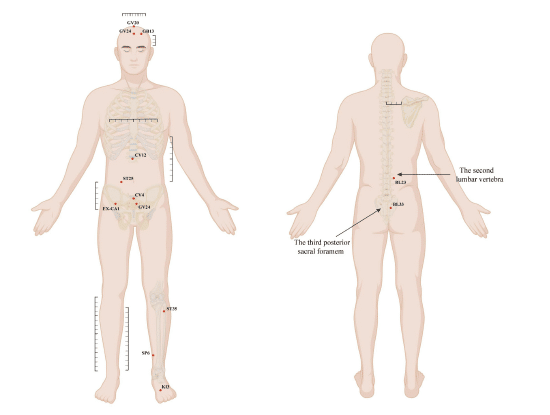
Vorderseite
- Lenkergefäß 20, Lenkergefäß 24
- Gallenblase 13
- Ren Mai 12
- Magen 25
- Ren Mai 4
- Niere 12
- Extrapunkt Abdomen 1
- Magen 36
- Milz-Pankreas 6
- Niere 3
- Leber 3
Rückseite
- Blase 23
- Blase 33, tief gestochen bis in das 3. Sakralforamen (60–70 mm), mit Elektroakupunktur verbunden
QUELLE: Su, C., Wang, X., Liu, X., Yang, L., Su, T., Wang, H., Li, Y., Zhao, C., Zhang, C., Xiang, W., Tong, G., Chen, L., Zhao, F., Xu, H., & Fang, Y. (2026). Effect of acupuncture for poor ovarian response: a multicenter randomized controlled trial. Frontiers in Endocrinology, 17, 1765527. https://doi.org/10.3389/fendo.2026.1765527